


Guide: Common issues and recovery after C-section
9 Oct. 2025
Verified by

Scan the QR code with your phone’s camera to download the app

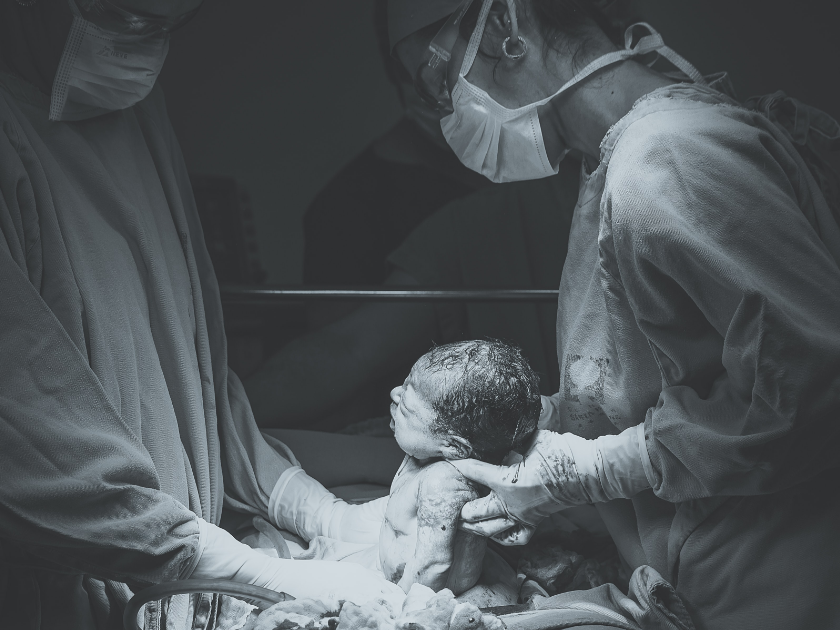
In this guide, we will go through common problems that can arise during a C-section, regardless of whether it was planned or not. Remember that the journey to recovery is individual and any discomfort will be experienced differently from person to person.
Feel free to start by reading our article “How a C-section works”.
In this guide
After surgery
If you are sedated because of a C-section, it is common to feel tired and sometimes nauseous afterwards. The midwife will feel your stomach and make sure your uterus has contracted properly. She will also make sure that you are not bleeding too much from your vagina or from the wound on your stomach. Some people will keep the catheter that was inserted during the operation overnight and in other cases the midwife will take it out the same day. The wound on your stomach may hurt for a couple of weeks, sometimes longer. However, it is important that it feels better and better every day and the bandage will be checked regularly by staff. You will be offered painkillers for the first few days. It is common to stay 1-2 days at the maternity ward after a C-section and in some cases even longer. You may need to stay longer if you lost a lot of blood during birth, your baby is not well, you develop an infection in your uterus or if there are difficulties with feeding your baby.
On the same day or the day after your operation, you will be helped to get up and to stand. Exercise is important for healing and for the bowels to get going again after surgery. Climbing stairs, going for walks with the buggy, carrying your baby and the baby carrier are not things you need to avoid for the sake of healing. However, heavy lifting beyond these examples should be avoided for the first two weeks after a C-section. Listen to your body to feel what you are capable of.
Surgical scars
In the vast majority of cases, a thread is used that disappears by itself a couple of months after the operation. The dressing covering your wound should remain for five days unless otherwise instructed. Then you can remove it yourself and apply surgical tape to protect the scar. If you have thin strips of tape under the bandage that holds the wound together, you can also put surgical tape over it here and let it sit for another 1-2 weeks, alternatively until it comes off on its own. Should the tape itch or bother you, it is good to remove it earlier. Since your scar is fresh, your skin will be red and lacks protective pigment. Be sure to cover up, avoid strong sun, or use high-factor sun cream on the scar for the first year after your C-section.
The surgical wound itself may hurt when you cough, sneeze or laugh. Then try pressing your hands or, for example, a pillow against the wound as “support”.
Getting an infection in the wounds is unusual thanks to the fact that you receive antibiotics in connection with your operation. However, should you have any of the symptoms below, you should contact your gynaeacological emergency department or health centre:
Vaginal bleeding
Everyone bleeds from their vagina after childbirth. This is called lochia and comes from the wound left behind by the placenta after it detaches from the uterine wall. Lochia begins as a heavy period, then turns more brownish and finally becomes lighter before stopping. During the 4-6 weeks that it is common to bleed, the smell and consistency of the bleeding can also vary.
After childbirth, your uterus is extra sensitive and susceptible to bacteria and there is an increased risk of infection. A uterine infection can be treated with antibiotics, and in some cases the woman may need to be admitted to hospital to receive antibiotics as a drip directly into the blood. Since you are extra susceptible to infection at this time, you should avoid bathing (showering with the bandage is fine and it does not need to be changed afterwards), avoid menstrual protection that you insert into your vagina (tampon or menstrual cup) and remember to use a condom during sex. However, you should avoid intercourse while you have fresh bleeding.
If you are worried, you can seek care at a health centre or a midwifery clinic. However, go to an emergency department or a gynaecological emergency department (except in the first week when you should contact your maternity clinic) if one or more of these statements match your condition:
Afterwards
Pretty soon after the baby is out, your uterus will begin contracting again. This is called afterpains and can hurt. If you have just given birth, it is more likely that you will feel strong, painful afterpains. Most often, they are felt more when breastfeeding, but the pain usually subsides after 3-4 days as the uterus contracts. It may be worth testing whether a heating pad or tens machine relieves and take paracetamol and ibuprofen if necessary.
Breastfeeding and milk production
If you want to breastfeed your child, it is good to be prepared for the fact that it can be a bumpy road before breastfeeding goes smoothly, regardless of whether you gave birth vaginally or by C-section. After the operation, it may be difficult for the woman to hold her baby herself and milk production may be slow. This certainly does not mean that people who gave birth by C-section, will not be able to breastfeed, just that it may take a little longer for the process to start. Let your baby nurse frequently and have as much skin-to-skin time with the baby as you can. It is normal to breastfeed a lot in the first 24 hours before the mature milk starts flowing. 8-12 times a day and more often is common and can come as a shock to the new and tired mother. When the mature milk flows between days 3-5, you can get something called milk stasis, the breasts become like hard bombs and you can feel a little sick. Here is the best thing you can do to breastfeed, preferably following your baby’s cues. If your breasts feel very tense and you need to relieve the pressure in your breasts between feedings, you can take a warm shower while lightly massaging your breasts. Also try using something popularised by Jean Cotterman known as Reverse Pressure Softening, where you place your fingertips around the areola and press for a couple of minutes. This causes the milk and tissue fluid to be pushed backwards, which leads to the nipple and areola softening and the baby can more easily get a good grip around the breast. It is also very common to have sore and tender nipples. If you get sore nipples, you can air them, lubricate them with breast milk and use special creams that can be bought at the pharmacy.
If you need support and tips regarding breastfeeding in the first week after giving birth, you can always call your maternity clinic. Don’t be afraid to seek help from friends, family and healthcare professionals. As with everything else when it comes to a newborn, no one expects you to know everything from day one.
In a way, both you and your baby are new to this world.
Read more about breastfeeding here.
You can also prepare before birth by starting to manually stimulate your breasts towards the end of your pregnancy. Don’t worry if nothing comes out when you express milk by hand. Just stimulating your breasts encourages the production of colostrum, which can facilitate the start of breastfeeding.
Lack of sleep
When labour is over and all you want to do is sleep, a new chapter begins with sleepless nights and days that run into one. Talk to your partner if you have one about how you can best take care of your home, each other and the baby in those first weeks. Take the opportunity to sleep for a while during the day when the baby sleeps so that you are more ready for a night where you are unsure how many hours of sleep you will get. If you are breastfeeding, it is difficult to share the responsibilities at night, but perhaps your partner can relieve you between breastfeeding sessions. There are many ways to comfort a baby besides your breast and it can be good for your partner to find their own tricks early on. Sleep is essential for all people, so if you feel extra sensitive, unfocused and stressed, it may very well be the lack of sleep that is haunting you. A tip for all parents out there is to take all the recovery you can get. If it’s a 10-minute power nap on the sofa in the middle of the day or a friend or relative coming over and carrying your baby around for a while so you can cook in silence. People often want to help and feel needed, but sometimes it is necessary to ask for it yourself.
Prolapse
Prolapse is when the uterus descends into the vagina, or organs around the vagina push into the vaginal wall. This is due to a weakened pelvic floor. Some form of prolapse is more common after a vaginal delivery compared to a C-section. However, it does occur, but you may not always be bothered by it and therefore do not need to seek treatment. For others, it can create a feeling of heaviness, chafing or problems when emptying the bladder and bowels.
There are some things you can do yourself to avoid the risk and to alleviate the symptoms of a prolapse. Among other things, doing tension exercises regularly to train the muscles in your pelvic floor, avoid heavy lifting and if you need to lift something heavy, remember to squeeze the muscles in the pelvic floor. It is important to always go to the bathroom immediately if you feel the need to poop. Also remember to eat fibre-rich food and drink plenty of fluids so that your intestines have the best possible conditions.
If you are bothered by something bulging out of your vagina, needing to urinate frequently even though you have just been to the toilet, an inability to empty your bowels properly, having a leaking stool or bleeding that you can’t see the cause of, it is important that you contact a health centre or gynaecological clinic. There is help at hand!
Urinary Tract Infection
After a C-section, it is more common to suffer from a urinary tract infection than otherwise. The most common cause of infection is the urethral catheter that is put on everyone who has surgery. A burning when you urinate and having to urinate frequently are two common symptoms. Most of the time, the urinary tract infection goes away on its own, but if the symptoms become troublesome, you should contact a health centre and see if antibiotics are needed. Drink plenty of water/fluid if you experience the urge to run to the toilet often. This can cause the urinary tract infection to go away on its own.
Baby blues and postpartum depression
Baby blues is something many new mothers have experienced. Hormones and the adjustment can cause feelings like depression and anxiety to take over. Some do not feel this at all, while others feel a deep sense of sadness and unhappiness. It can be helpful to remind yourself that this is very common and always passes. The so-called “newborn bubble” is in many cases far from perfect, cosy and peaceful all the time. Experiencing life as a roller coaster of emotions during those first weeks with a newborn is a reality for many women. However, if you feel strong feelings of depression, cry a lot and have difficulty bonding with your baby, you may have suffered from postpartum depression. Don’t be afraid to talk to your partner, if you have one, a friend, a family member or your children’s health centre. If the feeling of depression has not gone away after about two weeks and you feel that it is difficult to get up and face the day in the morning, it is time to seek help. Through your children’s health centre, you may be offered contact with a psychologist or doctor, if necessary.
Peeing and pooing after giving birth
It is usually said that three things must work after a woman gives birth. Pee, pooing and having sex. Not straight away, of course, but it is important to remember that these three things are basic needs and if these are not working properly, it will affect us in one way or another.
After the catheter is removed, you can try urinating by yourself. The spinal anaesthesia you receive during a C-section can impair your ability to urinate, but it is important to try to urinate as soon as you feel the need. Remember to drink plenty of water and eat fibre-rich foods to avoid constipation after childbirth. The pelvic floor is weakened even after a C-section and when under strain, small or large amounts of urine may leak out. Should this continue to be a problem, it is important that you bring it up at your follow-up with your midwife. Unless the doctor or midwife tells you otherwise, you can start doing tension exercises right after giving birth.
Separated abdominal muscles
Diastasis recti, or stomach muscle separation, is something you may have heard of before. During pregnancy, all layers of abdominal muscles are stretched and weakened. This is to make room for the growing uterus. After childbirth, these eventually find their way back together, but in some cases the connective tissue between the muscles remains stretched and the distance between the muscles becomes too great. Signs that you have separated abdominal muscles can be that your stomach sticks out, your stomach muscles feel weaker, you have problems with your pelvic floor and lower back, problems with urinary incontinence, etc.
It is not dangerous, but it is important to be aware of the condition so that you train your muscles in the right way. Contact a midwife or physiotherapist for an exercise program to strengthen the pelvic floor, obliques and back. In some severe cases, surgery may be needed to recover fully.
No pregnancy or birth is exactly like any other. The same applies to the journey to recovery. Be kind to yourself and let the inner and outer healing process take as long as it needs.


